Longevity
NAD+ Benefits: Injections, IV Therapy & What to Know
Longevity

NAD+ (nicotinamide adenine dinucleotide) is a coenzyme your cells use for energy metabolism and other essential processes, including pathways involved in DNA repair and cellular stress response. Researchers are studying whether supporting NAD+ may have applications in healthy aging. The benefits of NAD injections and NAD IV therapy are continually being researched.
If you found your way here because your energy, recovery, or mental clarity does not feel like it used to, you have probably already encountered plenty of claims about NAD+. In Scottsdale, AZ and throughout the Valley, interest in NAD+ has grown quickly alongside longevity medicine, advanced testing, and other approaches to health optimization.
At Health For Life Naturopathic Medicine, our collaborative medical team evaluates your symptoms, history, labs, lifestyle, and goals before determining whether NAD+ or another approach deserves a place in your individualized care plan.
NAD+ stands for nicotinamide adenine dinucleotide. It is a coenzyme, meaning a molecule that helps enzymes carry out chemical reactions throughout the body.
One of NAD+’s best-understood jobs is participating in redox reactions, the chemical reactions cells use to transfer energy. NAD+ and its reduced form, NADH, help move electrons through metabolic pathways that ultimately allow your cells to turn nutrients into usable energy.
More simply, it assists the body to turn the food you eat into energy, and supports the recovery process.
So while NAD+ gets plenty of attention in wellness circles, it is not a trendy molecule your body suddenly needs because you’re getting older. It is a basic and critical part of how the body works.
NAD+ participates in hundreds of cellular reactions, but two of its functions are energy metabolism and cellular maintenance.
Your cells contain structures called mitochondria, which help convert energy from the food you eat into a form your cells can use. NAD+ participates in the metabolic reactions that make that process possible.
NAD+ is essential in the processes that respond to DNA damage, metabolic regulation, stress response, and cellular homeostasis, meaning it’s critical in supporting your overall cell health.
When your cells can metabolize your food and repair cells, the body can function more optimally.
As we age, our cells age along with us.
And while changes in NAD+ metabolism have been observed with aging in animal models and in some humans, evidence for a universal age-related decline in NAD+ is still being collected.
For example, different tissues may behave differently, and factors such as inflammation, metabolic health, NAD+ production and consumption, disease processes, and cellular stress may all influence NAD+ availability.
Researchers are still working out what changes, where it changes, and how clinically important those changes are.
Currently, we do not have a simple equation where raising your NAD+ levels will reverse an age-related symptom. Many factors play into health as we age, and NAD+ could be one of them.
Researchers are interested in NAD+ because of its involvement in:
Researchers are investigating whether changing NAD+ availability could influence metabolic function, cardiovascular health, muscle function, inflammation, neurobiology, and other processes associated with aging.
Many of the strongest findings so far come from animal studies or studies of NAD+ precursors rather than direct NAD injections or IV therapy.
NAD can be administered through IV therapy and NAD injections. Neither route is necessarily better than the other,
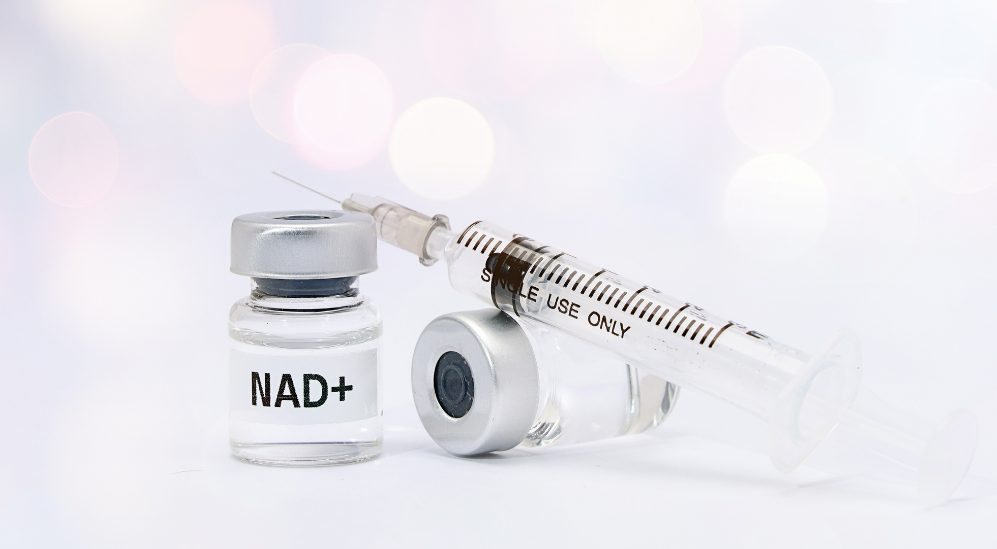
NAD injections deliver NAD+ into the body through a shot, typically administered under the skin or into a muscle. Compared with an IV, injections generally take less time to administer and don’t require sitting connected to an IV line.
NAD IV therapy delivers NAD+ directly into the bloodstream through an intravenous line, the same basic method used for other IV nutritional therapies. Because it enters the bloodstream directly, some people are drawn to IV administration when they’re comparing options.
The most obvious difference is how NAD+ enters the body.
An NAD injection uses a needle to deliver an injectable preparation without an IV line.
NAD IV therapy delivers NAD+ into a vein, so the compound enters the bloodstream through an intravenous line.
A provider may consider your health history, goals, other treatments, tolerance, and the quality of the available product before discussing whether either approach belongs in your care plan.
And sometimes the answer may be neither. That is part of individualized medicine too.
NR, or nicotinamide riboside, and NMN, or nicotinamide mononucleotide, are NAD+ precursors. A precursor is a compound the body can use as a building block to make another substance.
They are therefore related to NAD+, but they are not the same thing as receiving NAD+ directly.
Much of the human research commonly referenced in discussions about “boosting NAD” actually involves these precursors rather than IV or injectable NAD+.
Human trials have shown that oral NR and NMN can change circulating NAD-related metabolites. However, recent reviews have found that effects on measures such as physical function, metabolism, vascular health, and other healthspan-related outcomes are inconsistent and sometimes absent. (Gallagher & Emmanuel, 2026)
Women researching NAD benefits for women are often looking at NAD+ in the context of hormone shifts, energy, and recovery that come with different life stages, from postpartum recovery to perimenopause and menopause.
If fatigue or brain fog is the reason you are considering NAD+, looking at the larger picture of your hormones and health history may provide a more supportive course of action.
The FDA has specifically warned compounders about the use of food-grade NAD+ to prepare sterile intravenous products. According to the agency, ingredients labeled as food grade may pose contamination risks if they have not undergone appropriate processing for sterile drug compounding.
FDA has also received reports of severe chills, shaking, vomiting, and fatigue following injectable NAD+ products. The agency said those reactions were consistent with excessive endotoxin exposure, a type of contamination that can occur when sterile-product standards are not adequately met.
This warning should not be interpreted to mean that every compounded NAD+ product is contaminated or unsafe.
It does make sourcing, ingredient suitability, sterile compounding standards, and medical oversight reasonable questions to ask before receiving an injectable or IV product.
FDA has not approved NAD+ injections or IV therapy for longevity, energy, or general health optimization. This is an off-label use, which is a common practice among providers to give their patients a more personalized treatment plan that supports their health goals.
People who are already focused on longevity, exercise performance, recovery, metabolic health, or maintaining function as they age may reasonably want to understand whether NAD+ is a good fit for their health plan.
So may someone who feels persistently tired or foggy despite being told that their basic labs look normal.
But those symptoms are also a good reason to zoom out.
At Health For Life Naturopathic Medicine, your care team can evaluate hormones, thyroid function, metabolic health, nutrient status, sleep, digestive health, lifestyle, medications, and other relevant factors alongside your goals.
NAD+ may ultimately be one option worth discussing. Another approach may make more sense once the full picture is visible.
If NAD injections, IV therapy, or longevity medicine brought you here, the next useful step is determining what actually fits your health.
Health For Life Naturopathic Medicine works with patients throughout Scottsdale, Phoenix, and the surrounding Valley who want a more individualized approach to optimizing their health. Our team can review your history, current symptoms, testing, and goals and help you decide what deserves a place in your plan.
Become a patient at Health For Life Naturopathic Medicine or call 602-368-9211 to get started.
NAD+ (also commonly referred to as NAD) stands for nicotinamide adenine dinucleotide. It is a coenzyme used throughout the body in cellular energy metabolism and as a substrate for enzymes involved in processes such as DNA-damage response, cellular signaling, and metabolic regulation.
NAD injections are injectable preparations that deliver NAD+ with a needle rather than through an intravenous line, like with NAV IV therapy. Neither option is considered “better.” The way NAD+ is administered is up to the provider and patient.
NAD IV therapy administers NAD+ through an intravenous line directly into a vein. Human studies have examined how IV NAD+ is metabolized and, more recently, its short-term tolerability. The way NAD+ is administered is up to the patient and provider.
The primary difference is the method of administration. NAD injections deliver an injectable preparation with a needle without using an IV line, while NAD IV therapy administers NAD+ through a vein. One route does not necessarily provide better wellness outcomes.
NAD+ does not necessarily decline in the same way, at the same rate, or in every tissue simply because a person gets older. The optimal support for aging changes from patient-to-patient, and should be addressed with a comprehensive picture of your health.
NAD+ is essential for energy metabolism and participates in pathways involved in cellular maintenance and stress response. NAD+ could support healthy aging and metabolic health.
Peluso, A., Damgaard, M. V., Mori, M. A. & Treebak, J. T. (2021). Age-Dependent Decline of NAD+-Universal Truth or Confounded Consensus?. Nutrients 14(1). https://doi.org/10.3390/nu14010101
Yaku, K. & Nakagawa, T. (2021). Preclinical and clinical evidence of NAD+ precursors in health, disease, and ageing. Antioxidants & Redox Signaling 34(3), pp. 169-185. https://doi.org/10.1089/ars.2020.8250
Gallagher, C. & Emmanuel, O. O. (2026). NAD⁺ supplementation for anti-aging and wellness: A PRISMA-guided systematic review of preclinical and clinical evidence. Ageing Research Reviews 116. https://doi.org/10.1016/j.arr.2026.103057
(November 4, 2024). FDA reminds compounders to use ingredients suitable for sterile compounding. FDA. https://www.fda.gov/drugs/human-drug-compounding/fda-reminds-compounders-use-ingredients-suitable-sterile-compounding
Disclaimer: The information in this blog is for educational purposes only and is not intended as medical advice, diagnosis, or treatment. FDA has not approved NAD+ injections or IV therapy for longevity, energy, or health optimization. Any NAD+ therapy recommendations at Health for Life Naturopathic Medicine are made based on individual evaluation and clinical judgment. Always consult with a qualified healthcare provider before starting any new treatment protocol.